Suluh-budiman-BI-new
Introduction to

SULTAN IDRIS EDUCATION UNIVERSITY (UPSI)

Universiti Pendidikan Sultan Idris (UPSI) was established on 1st May 1997 under the Order of Universiti Pendidikan Sultan Idris (Corporation) 1997 and
the Order of Universiti Pendidikan Sultan Idris (Campus) 1997, as published in the Government Gazette P.U (A) 132 & 133 dated 24th February 1997.

Located in Tanjong Malim, Perak Darul Ridzuan, UPSI has two campuses: Sultan Abdul Jalil Shah Campus (KSAJS) and Sultan Azlan Shah Campus (KSAS).
Both campuses are uniquely distinguished by their focus on educational leadership, rooted in historical splendour and committed to leading global change.

UPSI is committed to driving change in education by disseminating knowledge through teaching and learning, research, publication, negotiation, and community
service. This is aimed at achieving excellence in human capital development at both domestic and international levels.

100 Years

1917
1922–1957
1957–1987
1987–1997
1997 – Present

Proposal for Establishment

  • R.O. Winstedt proposed the establishment of a teachers’ college.
  • Tanjong Malim was chosen as the most strategic location based on geographical conditions and terrain factors.
  • It was named after Sultan Idris Mursyidul Adzam Shah, the 28th Sultan of Perak (1889 to 1916).
  • August 1919: Campus construction began on a 64-hectare site.
  • 29 November 1922: The building was fully completed, featuring Gothic Medieval architectural design.
  • 1922: Officially inaugurated by Sir W. George Maxwell, Chief Secretary of the Federated Malay States.

SITC Era

  • 1922: The first 120 students were trained in teaching, handicrafts, and agriculture.
  • A historic milestone: A new era of Malay and vernacular education in Malaya, Brunei, Borneo, and Singapore.
  • 1924: The first 58 trained teachers graduated
  • The Writing and Translation Office, led by Za’ba, elevated the Malay language and shaped the nation’s civilization.

MPSI Era

  • 1957: SITC was renamed Sultan Idris Teachers’ College (MPSI) in line with the Razak Report.
  • The Malay identity became more prominent; a platform for nationalism and intellectual discourse.
  • A forum for scholarly debate, nationalism, and Malay as a body of knowledge.
  • Creative writing flourished, producing major national literary figures (Shahnon Ahmad, Kemala, Rahman Shaari, and many others).

IPSI Era

  • 1987: MPSI was upgraded to Sultan Idris Teacher’s Institute (IPSI).
  • Introduced the Special Teacher’s Certificate Course (KSPK, 1987) and the Postgraduate Teaching Course (KPLI, 1988).
  • 1993: Established twinning programmes with local universities.

UPSI Era

  • 1997: IPSI was upgraded to Universiti Pendidikan Sultan Idris (UPSI) through the Government Gazette.
  • 1 May 1997: UPSI was established; it began operations with 350 students and 29 academic staff.
  • The first Vice-Chancellor: Datuk Dr. Ashari Che Mat, supported by a team of academic and administrative leaders.

mace

Mace

Explanation of the University Mace

Originally serving as a weapon, the mace was transformed into a symbol of dignity and authority. Historical records indicate that on 19 March 1952, the Conference of Rulers presented a mace to the Legislative Council. Subsequently, both state maces and university maces were created as symbols of authority to confer degrees. Recognising its significance, Universiti Pendidikan Sultan Idris (UPSI) crafted its official mace on 18 December 1998. Made of sterling silver (P25Ag), it is 22-gauge thick and measures 105 cm in length.

The ceremonial mace was a royal gift from His Majesty the Yang di-Pertuan Agong, presented in conjunction with the installation of the University’s first Chancellor, Her Royal Highness Raja Permaisuri of Perak Darul Ridzuan, Tuanku Bainun, during the First Convocation Ceremony on 4 December 1999. The mace is traditionally used in official university events, such as convocation ceremonies and other special occasions chaired by the Chancellor.

This mace symbolises the authority of the Chancellor as the Head of the University. Its design is divided into three sections: the head, the body, and the base, each carrying symbolic significance. The head represents doctoral scholarship (third degree), the body signifies master’s scholarship (second degree), and the base embodies undergraduate scholarship (first degree).

On the body of the mace are engraved the Malaysian coat of arms and the hibiscus motif, reflecting the institution’s affiliation with the Federal Government. Additionally, the University’s emblem is featured to signify its identity and role. At the base of the mace is a quill icon, symbolising the University’s dedication to intellectual thought and a research culture. The pedestal at the very bottom is adorned with cloud-scroll carvings of the Keladi Biak motif rising upward, representing the University’s aspiration to expand knowledge while upholding tradition and faith in the Almighty.

The selection of the Keladi Biak motif as the convocation ornament of UPSI carries its own significance. Traditionally associated with Minangkabau decorative art, it reflects the versatile character of the Minangkabau people across various aspects of life. Its choice symbolises the adaptability of Anak Kandung Suluh Budiman (graduates of UPSI) as educators capable of adjusting to changing times, as well as embracing the diverse ethnic and cultural backgrounds of Malaysian society, in particular, and the world in general.

On 30 November 2021, Universiti Pendidikan Sultan Idris received a new mace to replace the existing one. While the new mace retains the original motifs and features, it is enhanced with additional elements, such as 24K gold-plated carvings, to underscore the grandeur of an educational institution led by the Chancellor as the Head of the University.

Logo

shield

Explanation of the UPSI Logo

Logo-UPSI-2018-Confirm-With-Stroke

Logo Concept

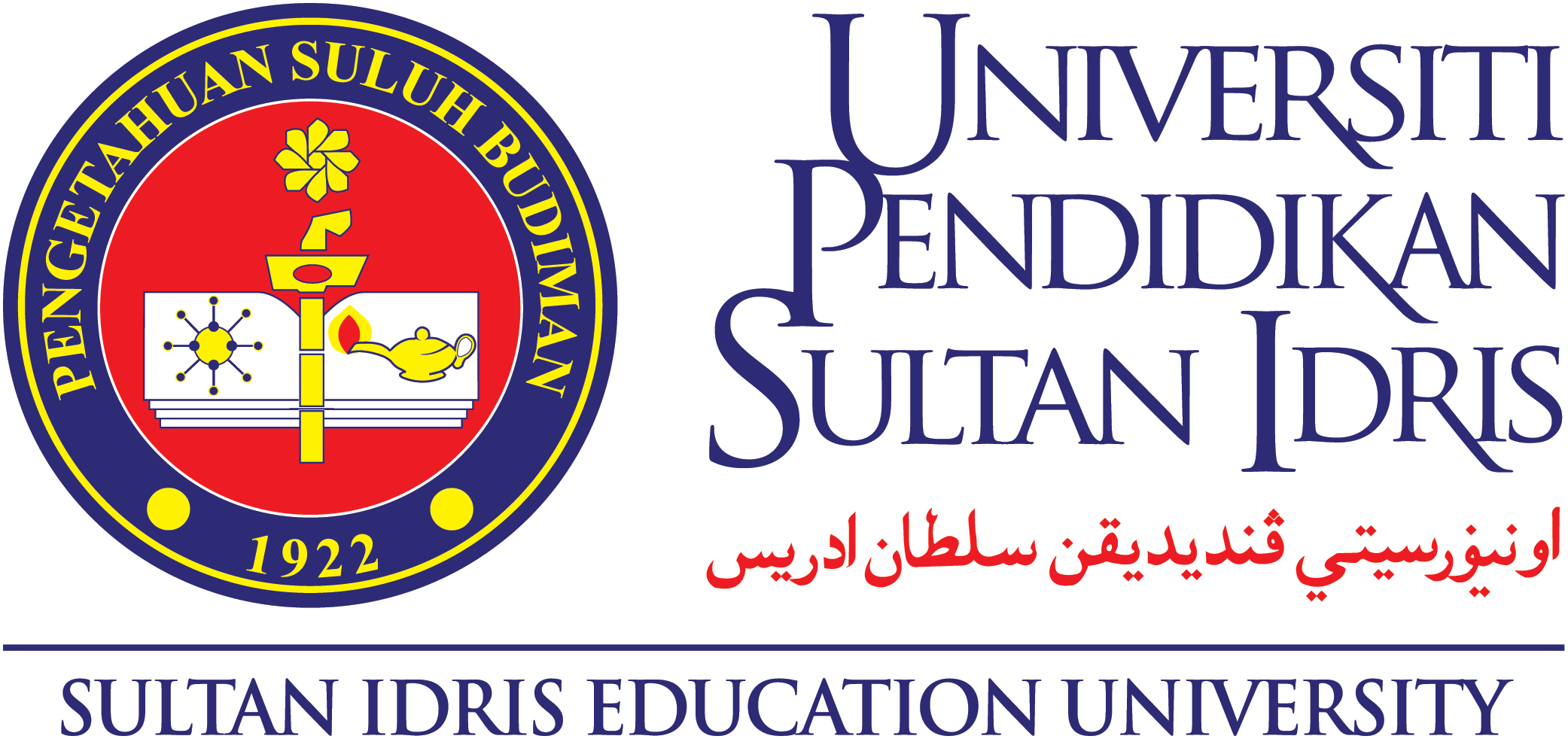
The two circles of the UPSI logo symbolise perseverance, ambition, and dedication. The blue outer circle bears the sacred motto of the university and the year of its establishment, engraved to reflect its foundational values. The red inner circle features a floral design, a keris, a lamp, a yellow molecule, and a white book — each representing the qualities necessary to realise the university’s vision and mission.

University Name
The name of the university is presented in two languages: Malay (including Jawi script) and English.

On the right side of the logo, the words ‘Universiti Pendidikan Sultan Idris’ (UPSI) are printed in Trajen Pro Small Cap font in Malay, written in blue, to complement and balance the logo. The design of the logo is dependent on the logotype. In Malay, the university’s name is emphasised by enlarging the font size to reflect the spirit of nationalism. Additionally, the university’s name is written in red in Jawi script and positioned below the main logotype. The Jawi script represents ethnic heritage, and UPSI is committed to preserving and promoting this cultural heritage in the future.

Below the fine line, the name of the university is stated in English as ‘Sultan Idris Education University’ (SIEU). In a globalised world, it is important to present UPSI with a recognisable and understandable name to the international community. The use of English is strategic, aiming to positively influence and shape the perception of the university worldwide.

Corporate Blue: Blue symbolises loyalty, professionalism, and unwavering ethics in fulfilling UPSI's mission and goals.

Yellow: Yellow represents sincerity and integrity in carrying out the responsibilities entrusted to the university.

Red: Red reflects the prominent, dynamic, and progressive image of the university, as well as its honourable values, which are essential in achieving the university’s vision.

Motto: The motto of SITC, ‘Pengetahuan Suluh Budiman’ or ‘Knowledge is the Beacon of Pure Character,’ has been maintained even after the establishment of UPSI. The motto emphasises the university’s aspiration to enrich and instil knowledge. The flaming torch symbolises the boundless power of knowledge that burns within every individual, guiding them toward a better and more fulfilling life. Nothing is purer than the burning desire to pursue knowledge.

Yellow Dots: The two yellow dots in the UPSI logo represent the determination of SITC and UPSI to uphold unwaveringly the oath and pledge of the motto ‘Knowledge is the Beacon of Pure Character.’

Arabesque Form: The eight-calyx flower, inspired by an Islamic motif, reflects the purity of knowledge, education, sincerity, and responsibility. It also symbolises the eight key elements in the university’s philosophy: Piety, Wisdom, Culture, Civilisation, Humanity, Society, Nationalism, and Excellence.

Keris: The Keris is a symbol of authority and responsibility entrusted to UPSI as a centre for generating knowledge in education, arts, music, language, literature, as well as science and technology.

Lamp: The lamp represents the unique history and establishment of the university, which began with SITC. It signifies the rays of knowledge that illuminate the souls of our nation. It is hoped that through research and experimentation, these rays of knowledge will continue to flourish.

Molecule: The molecule symbolises the university’s effort to produce active and progressive individuals in the fields of science and technology through the implementation of its philosophy.

Book: The book signifies UPSI's identity as a professional learning institution that is centred on the pursuit of knowledge.

Three Round Circles: The blue, yellow, and white circles represent the primary functions of UPSI: teaching, conducting research, and providing services to the community.

Overall, the combination of symbols, shapes, motifs, and colours in the UPSI logo sketches the university's unique and professional profile as a higher institution of learning. It also endows UPSI with a strong corporate image that reflects its quality, competence, and unwavering determination.